

Frederiksberg Svømmehal
Art and public bathing in Copenhagen
A public swim hall in Frederiksberg
Sitting here in Copenhagen, in the middle of a Danish winter (colder than last year, though still mild compared to the Montreal winters I’ve grown accustomed to), I’ve been thinking a lot about baths, warming, swimming, and saunas.
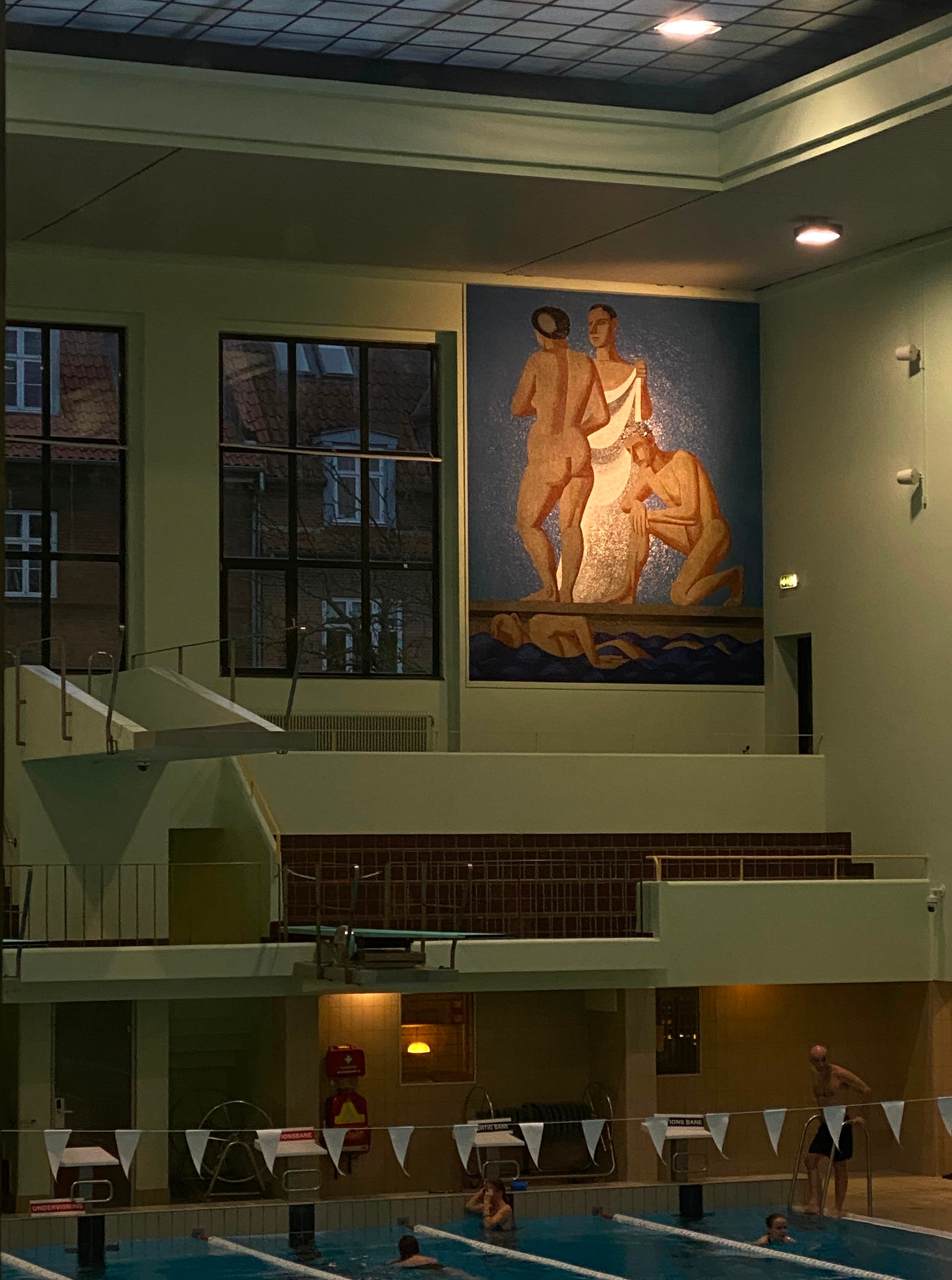
One of the most special swimming halls I’ve visited has to be Frederiksberg Svømmehal, here in Frederiksberg (a city within the city of Copenhagen) — one of Denmark’s oldest and most charming public pool buildings. It was designed by architect A.S.K. Lauritzen and opened in 1934 as a civic swimming bath and hygiene facility at a time when private bathrooms were not common in homes. The building is a great example of Danish functionalist architecture and features monumental mosaics by Danish artist Vilhelm Lundstrøm.
Between 2021 and 2024, the swim hall went through an extensive renovation led by Cornelius Vöge, which thoughtfully restored original elements, signage, colour schemes, and the original café.
Today, Frederiksberg Svømmehal operates as a multifunctional space: part public swim hall, bathhouse, wellness facility, and neighbourhood social space.
Built for public life
Public bathhouses were once a vital part of urban life in Copenhagen, especially before bathrooms became common in private homes. Frederiksberg Svømmehal was constructed during a period when architecture was used as a tool for improving public health, combining functionality with a sense of dignity and care in design. Lauritzen’s approach reflects Scandinavian functionalism, emphasizing clarity, proportion, and durability rather than ornament. This aligns with a broader Danish tradition of designing civic spaces that are quietly integrated into daily life rather than monumentalized.
The recent renovation reflects a common practice in Copenhagen: maintaining historic public buildings as active parts of daily urban life, with respect for the original design. The intervention focused on preservation, careful upgrading, and restoring the building’s original atmosphere while adapting it for contemporary use.
Highlights & Colour Story
The building itself is very much a Danish take on functionalism. Instead of a white rendered façade, it is constructed in traditional red brick and still reads “Svømmehal – Bad” (Swimhall – Bath) in large lettering on the exterior.
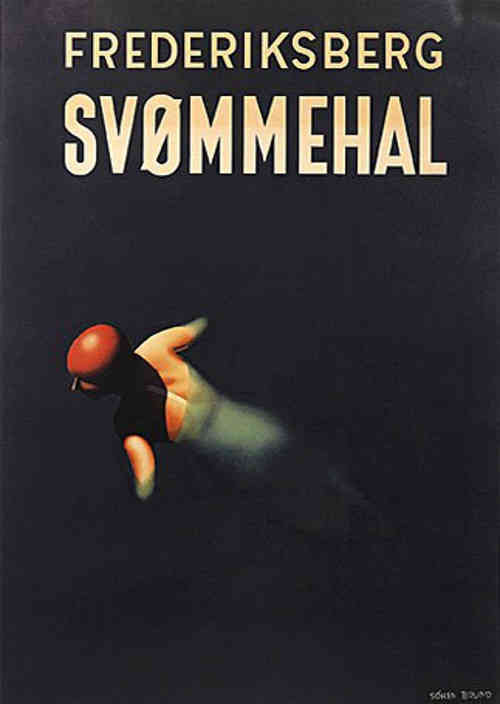
Inside, many original details have been preserved and restored, and you immediately feel the building’s age when you enter the lobby — but in a new and comfortable way. Large glass windows and doors open the space up, and during my visit the lobby was decorated with original posters from the 1930s and 40s promoting the swim hall — beautiful graphic works in their own right.
Moving through the building, you pass into the ground-floor cafeteria, which has been restored to its original character and looks directly onto the pool deck. The yellow interior and warm wood details contrast beautifully with the blues and teals of the pool hall and water beyond the windows. I especially love this photograph from the opposite side of the swim hall, where the café colours sit opposite the pool space — it’s such a strong and fun palette.
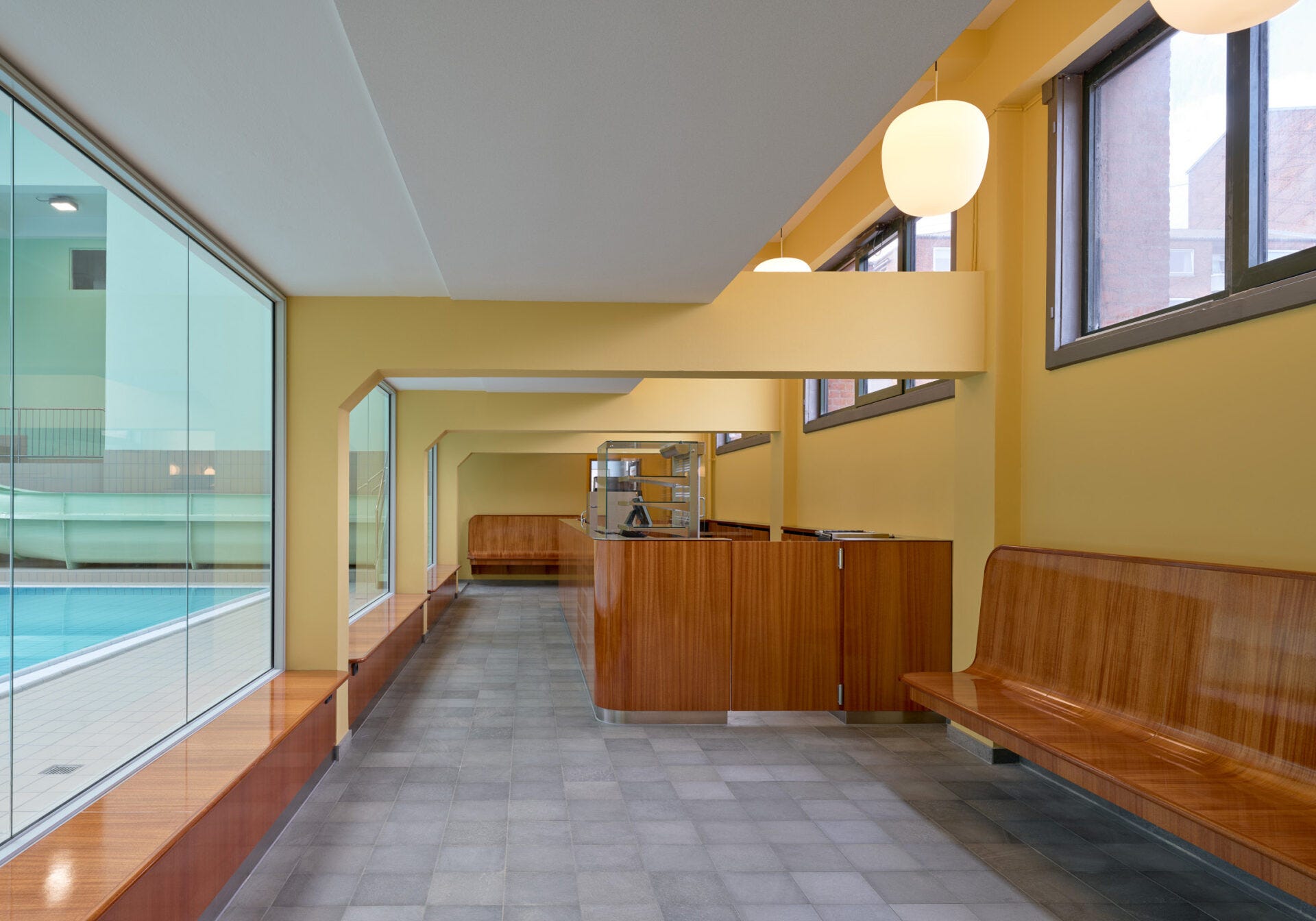
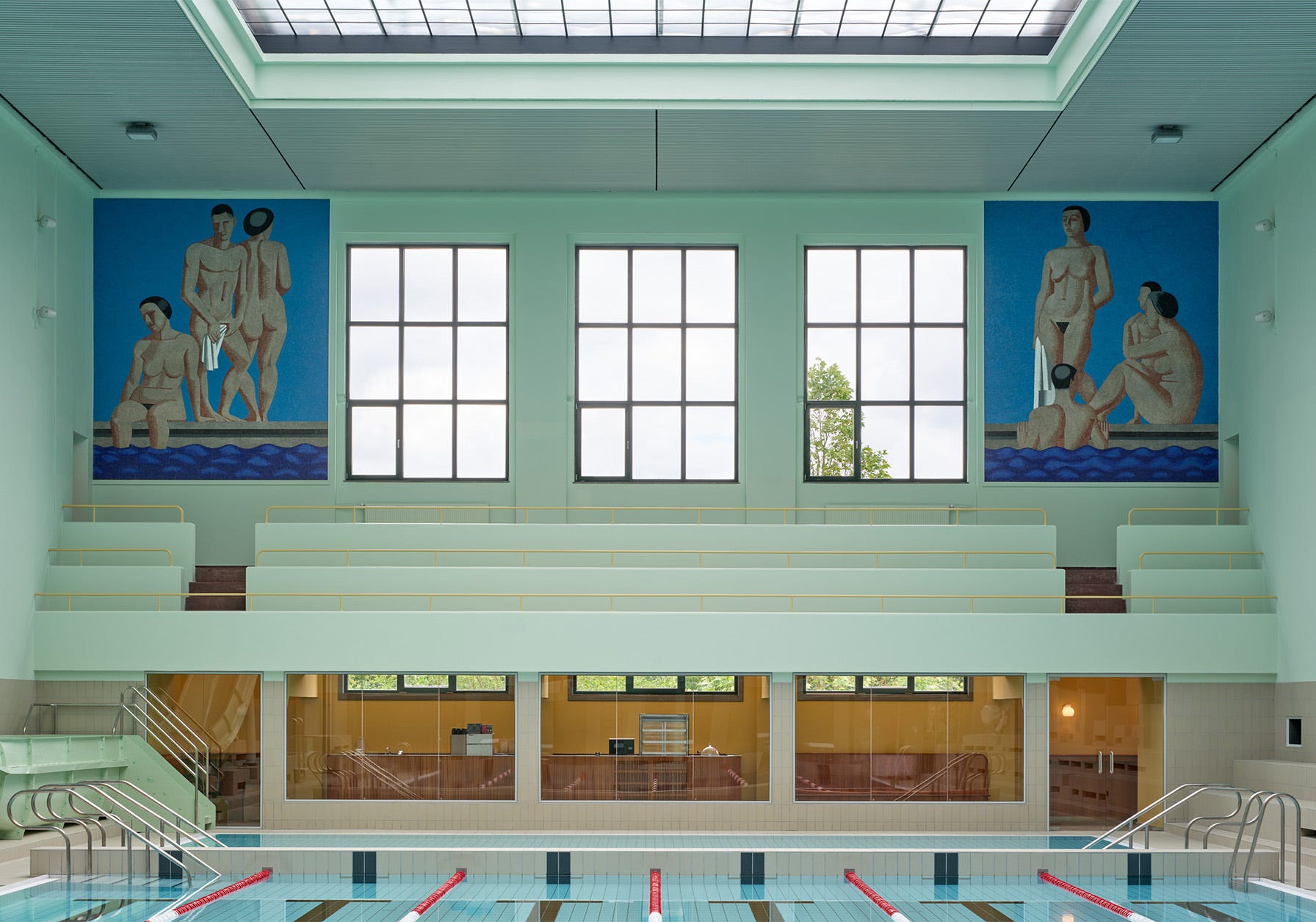
The café itself feels like a moment back in time. The wooden details, lighting, counters, and integrated bench all work extremely well within the context of the swim hall.

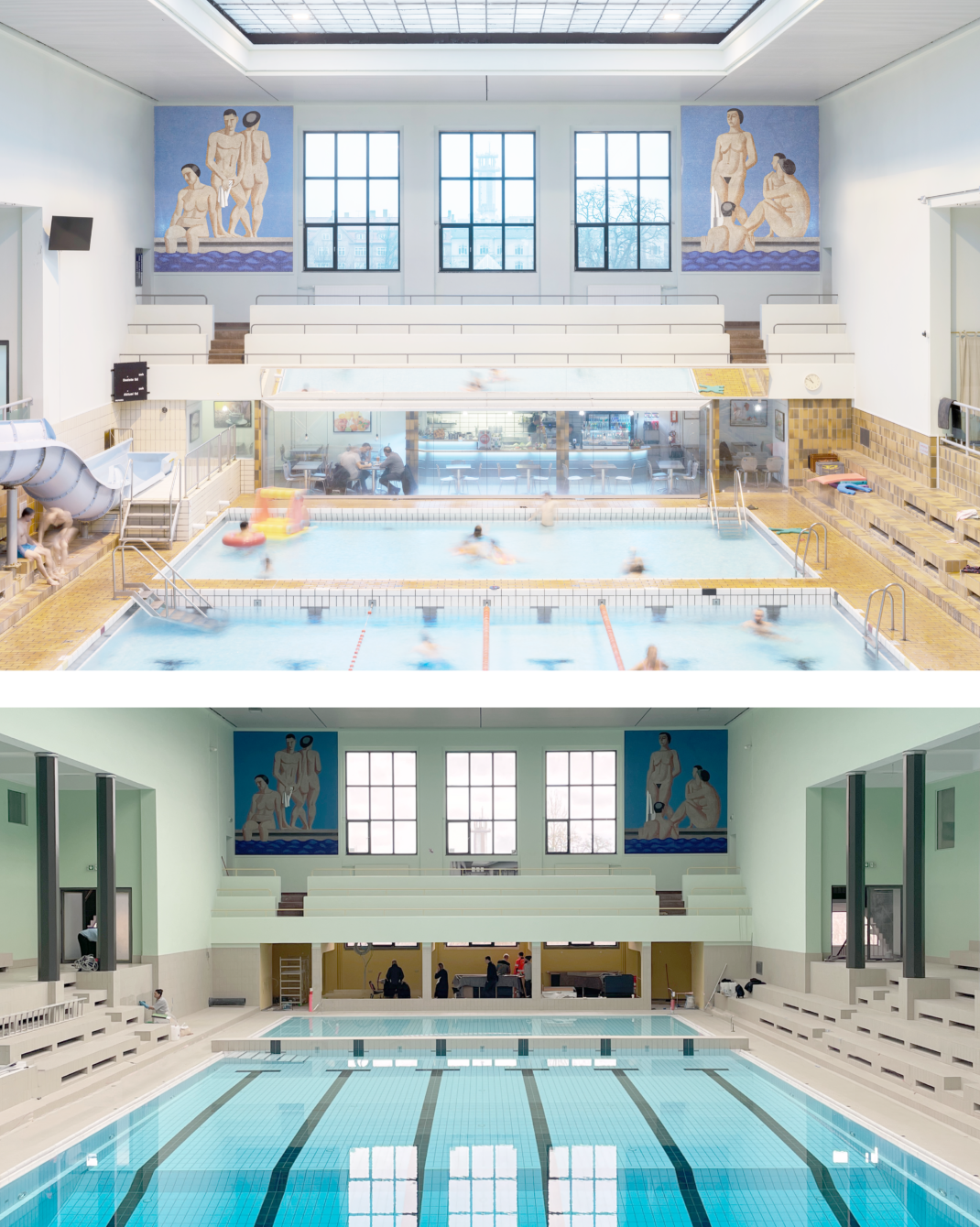
The swimming hall is naturally the heart of the building. From the spectator viewing deck, you get a full view of the space. Each of the four corners of the hall is anchored by massive, three-metre-tall tiled mosaics by Vilhelm Lundstrøm. Standing on the viewing deck, you are directly beneath them, looking up and noticing the fine grain of the small tiles that make up each piece. The towels carried by the figures almost glow, catching the light from the skylight and large exterior-facing windows.
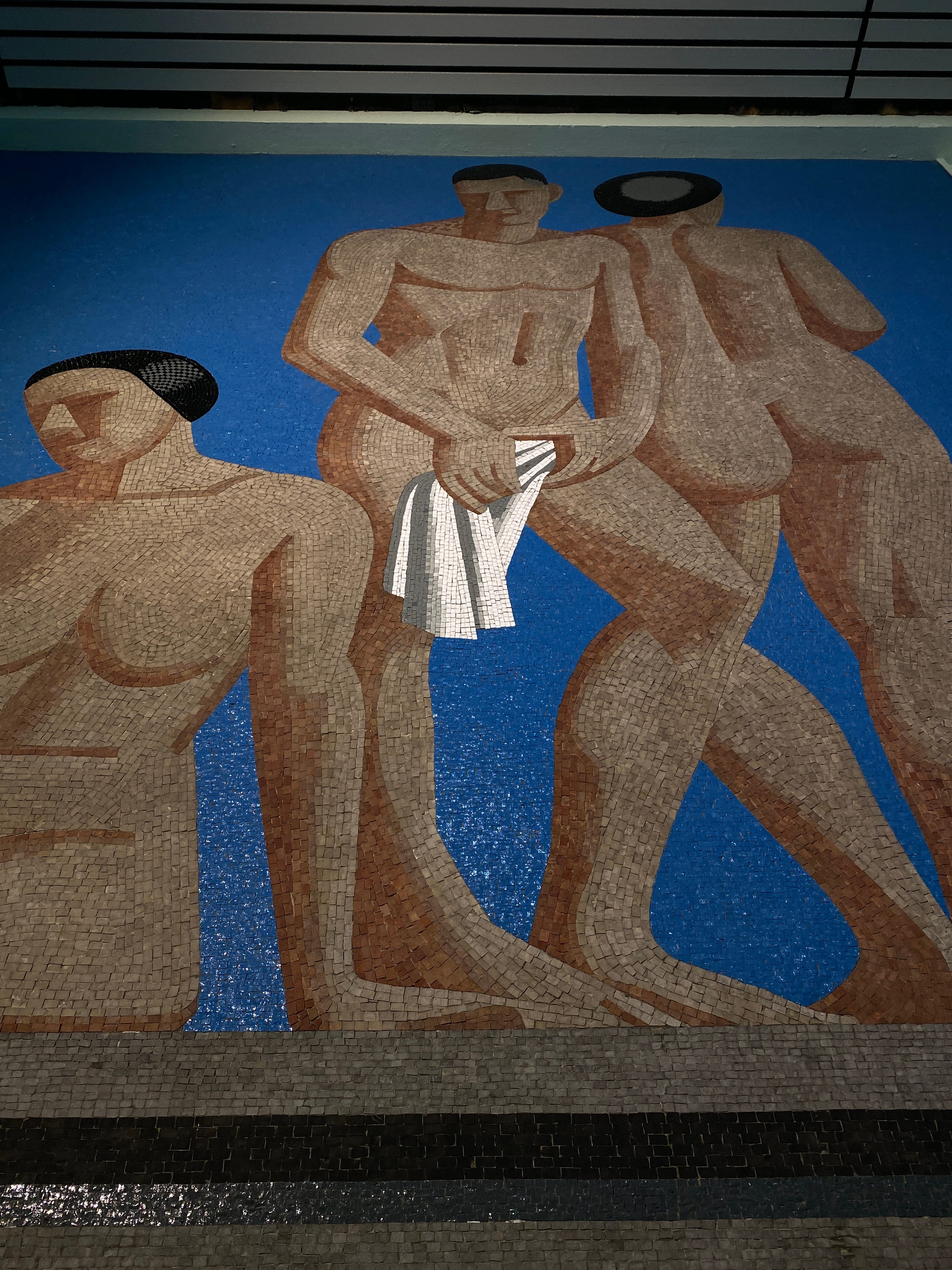
Lundstrøm was a highly notable Danish painter, best known for his still lifes and portraits — many of which can be seen at the SMK and around Finn Juhl’s house. This was his only large-scale public mosaic commission, supported by the Ny Carlsbergfondet. His painterly style translates surprisingly well into mosaic and really defines the space. Even though the swim hall was built as a very practical place for hygiene and exercise, the decision to integrate art clearly shows the intention to elevate the experience and make even this everyday ritual feel special.

The colour story throughout the viewing deck continues to be fascinating: yellow curved metal handrails, teal walls, red tiled floors. It all works remarkably well. It’s fascinating that this is the original palette from the 1930s — almost 100 years old now — and still feels so mature and finished, yet fun, playful, and familiar at the same time. In the pool space, there are two stepped viewing platforms framed by tall columns, subtly referencing Roman bath architecture and reinforcing the ceremonial, historic, and monumental quality of the space.
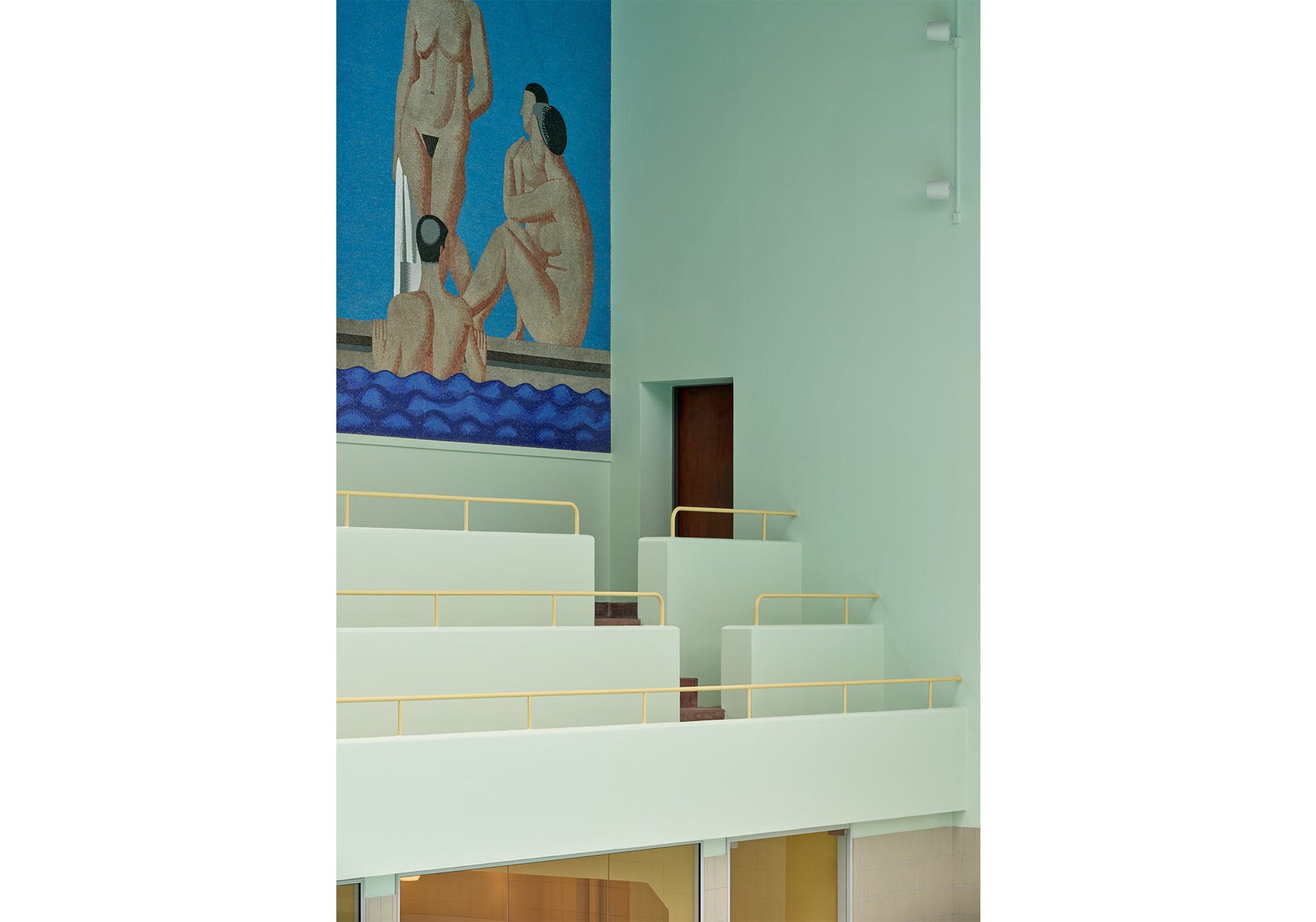
Cornelius Vöge and team collaborated with the National Museum of Denmark on the restoration’s colour work. Through colour-archaeological studies, the original 1930s palette was identified and carefully reinstated, ensuring alignment with Lauritzen’s architecture and Lundstrøm’s mosaics. Knowing that these colours are original to the building — and still feel so relevant today — makes the space feel even more special.

Below the main hall, the spa and changing areas continue this attention to detail. Hot and cold pools, saunas, tiled lounges, and original-style wood changing cabins have all been carefully restored. Even the signage — typography, colours, and symbols — feels considered and integral to the architecture.


Visiting Notes
Address: Helgesvej 29, 2000 Frederiksberg
Info: frederiksbergbadene.frederiksberg.dk
Further Reading
If you’re interested in Danish functionalism more broadly, this is a great place to start. https://medium.com/@corpus.cities/copenhagen-functionalism-6c1549ad3ab2
The building connects naturally to other archiectural works of the period, and hopeful future Sight Visit posts will look at including Vilhelm Lauritzen’s terminal, Radiohuset, and the Finn Juhl House.